
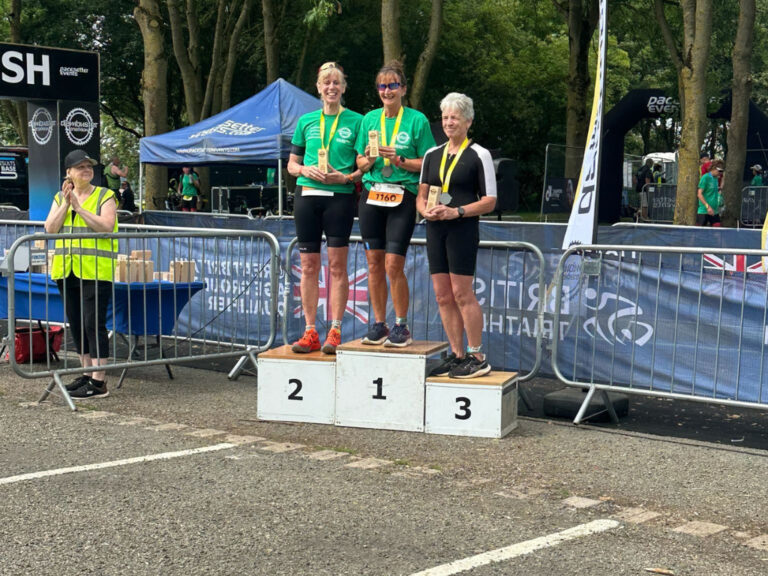
Last weekend I stood on a podium at the Dambuster Triathlon. The two women I stood alongside were also in their sixties. And honestly, they’re the reason I’m writing this.
Picture it. Rutland Water. A field full of women who’d swum, cycled and run their hearts out. Tired legs, big grins, and not one of them apologising for taking up space.
I came second in my age group. Proud of that. But the thing that stuck with me on the drive home wasn’t my own race. It was the company I was in. Women who’d decided, somewhere along the way, that getting older was not going to be the thing that shrank them.
So, this is my case for Pilates for women over 60 and really for any of us in midlife who’ve started to feel a bit invisible. Because that feeling is real. And it doesn’t have to be the end of the story.
The disappearing act
Here’s what I see all the time.
A woman hits a certain age. The menopause arrives. The body changes, the shape, the energy, the recovery, the confidence. And slowly, quietly, she starts to step back. Stops signing up for things. Stops pushing. Decides the best version of herself is behind her.
Let me be clear, because this matters: every single journey is different. For some women the menopause is brutal. The symptoms are hard, relentless, and not something you can just “train through.” I’d never wave that away.
But there’s a difference between “acknowledging” your body has changed and “hiding behind” it. Between giving yourself grace and giving up. The menopause is a reason to train differently. It is not a reason to disappear.
The evidence says we get better
If you think your best years are gone, I’d point you towards two things.
First, the book Ultra Women by Lily Canter and Emma Wilkinson, Sports Book of the Year in both the Guardian and the Times. It digs into the science of why women are quietly beating men in the world’s toughest endurance races. Turns out our bodies are built for the long game: fat utilisation, fatigue resistance, the ability to keep going. And women are often hitting their peak in endurance sport at an age when society has already decided they should be slowing down.
Second, watch Breakaway Femmes. It tells the story of the women’s Tour de France in the 1980s, six years of women racing the same brutal climbs as the men, drawing the same crowds and then it was cancelled and very nearly forgotten. Their achievements were made invisible. Sound familiar?
That’s the pattern, isn’t it? Women do extraordinary things, and the world looks the other way. I’m not interested in looking the other way anymore.
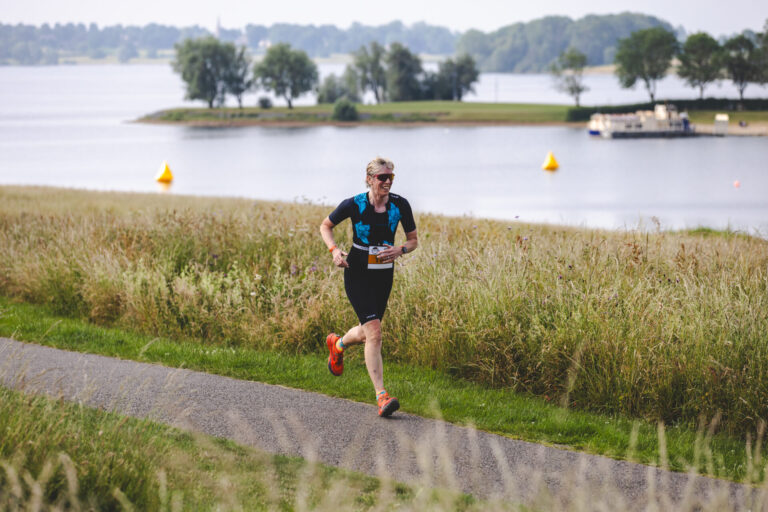
The two women on that podium
So yes, be in awe of those two women in their sixties I stood with last weekend. They are out there proving that sixty isn’t old. That you don’t need to hide away. That with the right training, you can still think big.
They haven’t let their age define them. And nobody handed them that. They built it.
Now, I’m not expecting you to go and do a triathlon. That genuinely isn’t everyone’s thing, and it doesn’t need to be. But if you’ve got a goal tucked away somewhere to start running, to manage a proper long hike, to play with the grandkids without seizing up, or honestly just to move through your day without pain then take the inspiration from that podium and start doing something for you.
It is not too late. It’s really not.
Why I always start people with Pilates
Here’s the practical bit. If you want to change how you move as you age, you have to change how you train. For most women, the place to begin is your core.
Pilates is so much more than “tummy exercises.” It works the deep muscles most workouts ignore: the transversus abdominis that wraps round you like a corset, the pelvic floor, the glutes, the muscles that support your spine, your hips, and your breathing. It trains control, stability and posture, the unglamorous stuff that holds everything else up.
What Pilates for women over 60 actually does for you
For running: a strong core stops you leaking energy with every stride. It keeps your pelvis stable, your posture tall when you’re tired, and it’s one of the best defences against the niggles – the dodgy knees, the grumbling hips, the lower-back ache that send so many midlife runners to the physio.
For walking and hiking: better stability on uneven ground, less back ache on the long ones, and the confidence to trust your footing.
For everyday life: getting up off the floor, carrying the shopping, twisting to reach the back seat, catching yourself when you stumble instead of going down. This is the stuff that keeps you independent for decades.
And the research backs it up, specifically for our age group:
- A study in the Journal of Sports Science and Medicine followed women over 65 doing an hour of Pilates three times a week. After just twelve weeks they were stronger, better balanced, and even quicker to react.
- A randomised controlled trial put women aged 60 to 80 through eighteen weeks of Pilates and saw real gains in core and hip strength and in balance.
- Before you tell me you need a fancy studio, one trial ran a Pilates programme entirely online with older adults and still had them walking further and balancing longer on one leg after twenty weeks.
That last one matters to me, because online is exactly how I teach. You can build this strength from your own front room.
Your move
You don’t need a wetsuit or a finish line. You need a reason and the willingness to start.
So, pick your thing. The run, the hike, the simple goal of feeling strong and capable in your own body. Then give yourself a foundation to build it on.