
The conversation I keep having
It usually goes something like this. A woman in her forties or fifties tells me she knows strength training for women runners is important. She’s read the articles. Her physio has mentioned it. Her knees aren’t happy after long runs anymore. But the thought of walking into a gym and picking up a barbell? No thank you.
So, she does nothing. And the niggles get worse. The hills feel harder. Recovery takes longer. And she starts wondering whether this is just what running after 40 feels like now.
If that sounds familiar, you are very much not on your own, this is the conversation I have more than any other. Here’s the good news: the gym-and-barbell version of strength training is just one option, and it’s almost never the right place to start. You can build proper, useful strength at home, in twenty minutes, in your running kit, with nothing but your own bodyweight. Once that strength starts showing up in your running, something quite lovely happens to your confidence. I’ll come back to that.
Why strength matters more after 40
The reason every running coach and physio is now banging on about strength training for women over 40 isn’t a trend, it’s biology. After 30, women lose roughly 3–8% of muscle mass per decade, and that drop speeds up after 40 as oestrogen declines. Bone density follows the same pattern. For runners, that means less power off the push-off, less shock absorption, more niggles, and slower recovery.
Resistance training is the single most effective thing you can do about it. The often-cited LIFTMOR trial showed that postmenopausal women with osteopenia and osteoporosis could safely improve bone density at the hip and spine through resistance training. Follow-up research has shown that moderate loads around 6 to 12 challenging reps, two or three times a week produce similar benefits. The American College of Sports Medicine puts the minimum effective dose at just two to three sessions a week. Not five. Not daily. Two to three.
So, if you’re picturing an hour in a sweaty gym five days a week, please let that picture go. It’s not what the evidence actually says.
Bodyweight is proper strength training
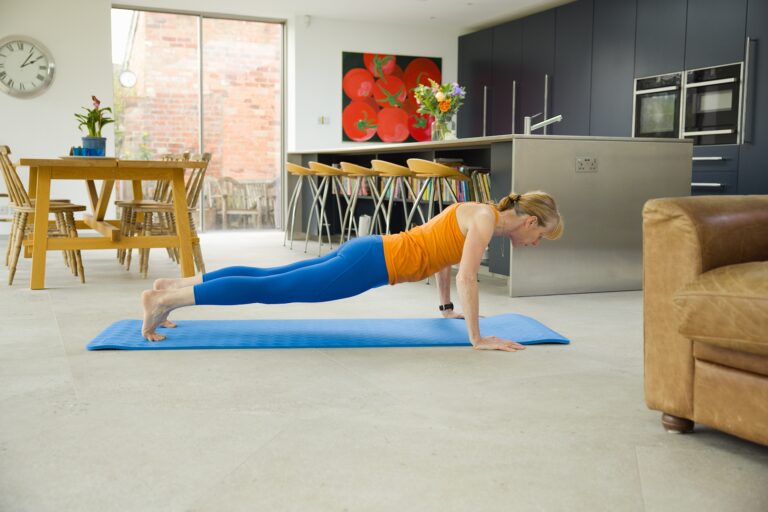
Here’s something the fitness industry doesn’t shout about, because it doesn’t sell memberships or kit: bodyweight exercises absolutely count. A squat is a squat whether you’re holding a dumbbell or not. A press-up loads your chest, shoulders, triceps and core just like a bench press does often more, because you’re stabilising your whole body at the same time.
For a woman who’s never done strength work before, starting with bodyweight is the right call because:
- You learn the movement patterns first. Squat, hinge, push, pull, lunge, plank. Get these right and every weight you ever pick up afterwards will be safer and more effective.
- Your tendons and ligaments adapt more slowly than your muscles. Bodyweight work gives them time to catch up. This is exactly why so many runners get injured when they jump straight into heavy lifting, the muscle is ready, but the tendon isn’t.
- You can do it tomorrow morning. No commute, no kit, no waiting for a squat rack, no eye contact required.
Where Pilates fits in
Now, I run a Pilates membership for runners, so of course I’m going to bang the Pilates drum. But the reason I built the membership in the first place is because Pilates does something for runners that almost nothing else does as efficiently.
Pilates is, technically, low-load high-rep strength training. You’re loading muscles under control, with tempo, through full range of motion, with the deep stabilising muscles working away in the background. For runners, that means:
- Glute strength and activation – the single biggest weakness I see, and the root cause of most knee, hip and IT band complaints.
- Core control under load – not “abs”, but the deep stabilisers that keep your pelvis level when you’re 12 miles in and tired.
- Hip mobility and ankle stability – the bits that fall apart first as we age, and the bits that make hills and uneven trails feel hard.
- Body awareness – knowing where your knee is over your foot, what your pelvis is doing, whether your shoulders are creeping up around your ears. Pure gold when you eventually pick up a kettlebell.
What I see again and again with my members is this. A woman starts Pilates feeling a bit apologetic about how weak she is. Six weeks in, she’s holding planks she couldn’t have dreamed of before. Twelve weeks in, her running feels different stronger, more efficient, fewer niggles. Then something shifts. She stops thinking of herself as someone who can’t do strength training and starts thinking of herself as someone who does. That’s the moment she’ll happily pick up a pair of dumbbells, because she’s no longer scared of them. She knows what her body can do.
That progression, bodyweight and Pilates first, then weights isn’t a workaround. It’s the sensible order.
Low weight high reps vs heavy weight low reps: what the research actually says
This is the question I get asked constantly, so let’s sort it out.
The honest answer is that both work for building muscle, as long as you take the set close to failure. A 2018 review in Frontiers in Physiology, and several studies since, have shown that lighter weights with high reps and heavier weights with low reps produce similar muscle growth provided in both cases you’re pushing the muscle until it genuinely can’t manage many more reps with good form.
But they’re not interchangeable, and the differences matter for us as runners.
Heavy weight / low reps (around 6–8 reps, roughly 70–85% of your max)
- Pros: Most efficient for raw strength and bone density. Better for stimulating fast-twitch fibres- the ones you use for hill sprints and a finishing kick. Shorter workouts, because each set is brief.
- Cons: Needs good technique, ideally with someone who knows what they’re looking at, at least at first. Needs proper kit. Higher injury risk if your form starts to slip.
Light weight / high reps (15–25 reps, lower load)
- Pros: Far more accessible at home. Lower joint load. Builds muscular endurance which is exactly what runners need. Easier to learn movement patterns safely. This is essentially what Pilates is doing.
- Cons: You really do have to work close to failure for it to build muscle, which is harder than it sounds. Less effective for bone density on its own. Sessions can take longer.
For most women in their forties and beyond, starting at home, the smartest approach is this: build a base with bodyweight and Pilates sessions high-rep work, then gradually add load. Once you’ve got the movement patterns down and your confidence up, even modest weights (a pair of 5kg and 8kg dumbbells) become genuinely powerful tools.
Training at home: honest pros and cons
Most of my members will do their strength work at home. They’re not heading to a commercial gym, and that’s absolutely fine. But it’s worth being honest about what you gain and what you have to think about.
Pros of training at home:
- Zero commute, zero excuses. You’ll actually do it.
- No self-consciousness, no waiting for kit, no overhearing CrossFit conversations.
- Cheap to set up: a mat, a resistance band, and eventually a couple of dumbbells will take you a long way.
- Easy to slot 20 minutes in around work, the school run, and your actual running.
Cons of training at home:
- No one to correct your form, so a guided programme (a class, a membership, a coach on video) becomes important.
- Progressive overload gradually making things harder and needs a bit of thought. You can’t just grab a heavier dumbbell off the rack.
- It’s easier to make excuses when no one’s watching. Structure helps.
The cons are exactly why I built the membership the way I did. LIVE Classes Monday to Friday you can follow along with, progression built in, and someone (me) giving you feedback, so you’re not having to figure it all out yourself. Plus 100’s of 10-minutes pre- recorded videos
How often, and for how long?
The minimum effective dose is genuinely small. The evidence says two to three sessions a week of 20–45 minutes each is enough to start seeing real changes in strength, bone density and how your running feels.
A realistic week for a runner over 40 might look like:
- Two short Pilates or bodyweight strength sessions of 20–30 minutes, ideally placed away from your hardest run days.
- Optionally a third session focused on glutes and hips, and once you’re ready some light dumbbells.
- Your normal runs, which will start to feel better within a few weeks.
That’s it. You don’t need to be in lycra five days a week. Consistency over months beats intensity over a fortnight, every single time.
The fear thing
Let’s name it. The real reason a lot of women don’t do strength training isn’t that they don’t know how. It’s that the whole world of weights feels like it belongs to someone else, someone younger, someone fitter, someone who already knows what a deadlift is. The gym feels like a room full of people who already know the rules of a game nobody taught you.
So here’s what I want you to take away.
- You don’t need to set foot in a gym to get the bone-protecting, muscle-building, injury-preventing, running-improving benefits of strength training.
- Bodyweight work and Pilates are proper strength training. They’re not the easy version. They’re the right starting point for most women, regardless of age.
- The strength will come, and the confidence will come with it. The dumbbells will start to feel like a natural next step, not a leap.
- Twenty minutes, two or three times a week, is enough to change how your running feels by your next race.
You’re already a runner. You’ve already proved you can show up consistently for something hard. This is the same skill, just in a different room.
If you’d like somewhere to start where the thinking has been done for you short Pilates and strength sessions designed specifically for runners over 40, sequenced so you build real strength without needing a gym that’s exactly what the membership is for. Come and find out more here