
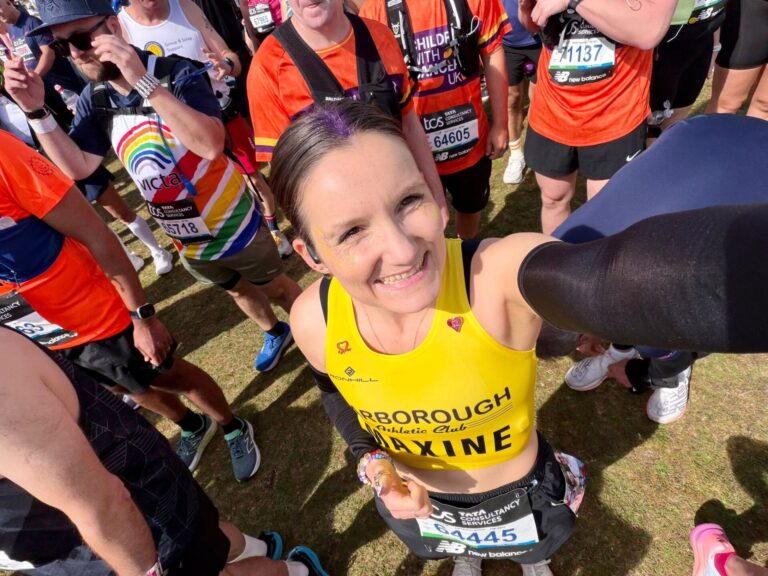
It’s taken Maxine 10 days to find the words.
Some achievements are too big to process straight away.
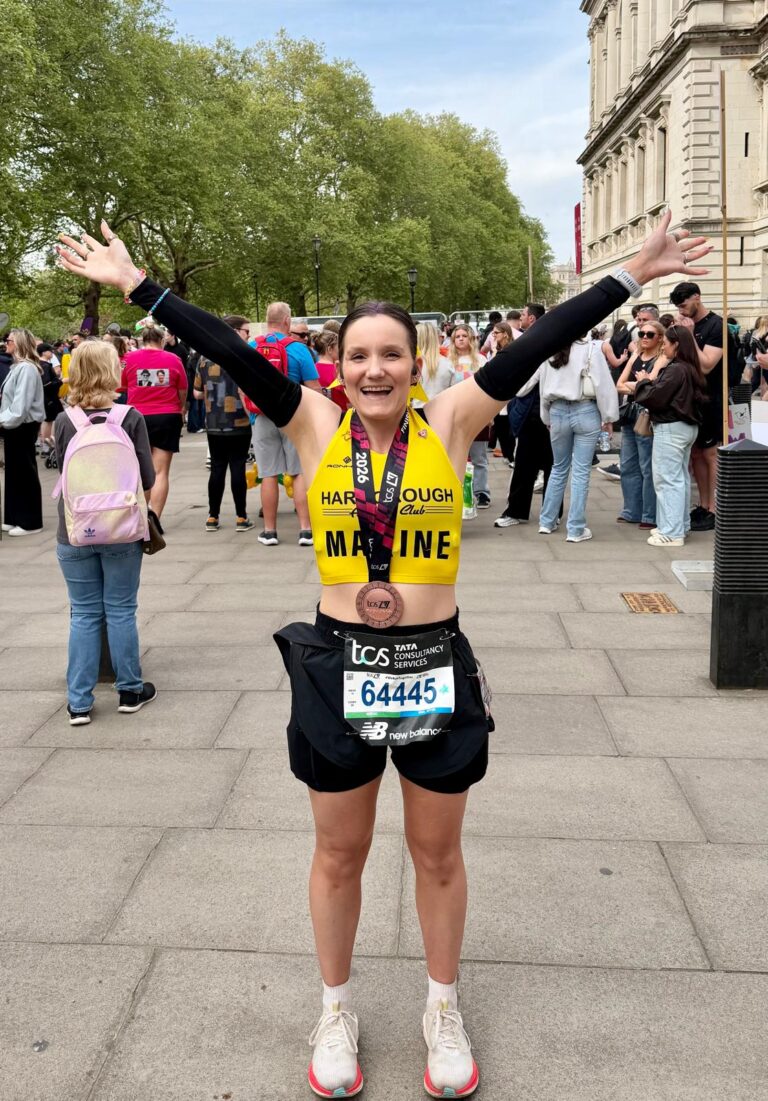
Ten days ago, she ran the London Marathon 2026. She crossed that finish line strong. Injury-free. Smiling. With her dad, Mum and Granny’s photo on her shorts – running in memory of her Dad and raising money for the British Heart Foundation. ❤️
Her story is one I want every runner to hear, especially anyone training for a marathon and wondering whether they’re doing enough off the road to get them to that start line ready.
Because Maxine’s story isn’t a “perfect” one. It’s a real one. And it shows what’s actually possible when you train smart, not just hard.
So, here’s how Maxine got to that start line ready, that finish line proud, and everything in between.

Meet Maxine
Maxine has been training with me for two years.
When she first came to me, she was a runner who wanted to get stronger, but she didn’t really believe she could. She’d had children, like so many of the women I work with, and she didn’t believe she could properly engage her core anymore. She didn’t believe in the process. She didn’t believe in herself.
That’s where so many runners start. And honestly? That’s the most important place to begin because everything that came next was built on slowly, steadily proving to her body and her mind what was possible.
Why Strength Work Matters Before You Start Training for A Marathon
Here’s the bit most runners get wrong: they start strength training when marathon training starts.
By then, it’s already too late.
Maxine’s words say it perfectly:
“I felt stronger at the start of this training than I ever had before.”
Why? Because she’d been doing Pilates and strength work with me for almost two years before her London training block began. The foundation was already there.
In our 1-2-1 sessions over those two years, we focused on:
- Mobility work to get her body moving well before her runs
- Core strength, single leg stretch, double leg stretch, scissors, criss cross, planks and side planks for pelvic stability
- Standing strength sessions using weights, working all the major running muscles, glutes, hamstrings, quads
- Calf raises and single leg work to build the resilience runners need on every stride
- Plyometrics once the foundation was strong enough to handle them
- And always, always going back to basics
Slowly, her body started to change. So did her running. Maxine started PB-ing her 10ks and road races with her club.
And then something shifted.
The belief kicked in.
Once she could feel the difference in her running, in her body, in her strength the mindset followed. She became determined to make the absolute most of the opportunity London had given her.
16 Weeks of Marathon Training. Zero Injuries.
This is the bit I want every runner to hear.
Sixteen weeks of building mileage. Long runs. Speed sessions. The lot.
And Maxine got to that start line uninjured.
In her words:
“Pilates and strength definitely helped protect my body from all the impact. The only slight niggle I had was towards the end my left hip felt a bit tight after long runs. Stretching, mobility and a sports massage sorted it. I had no injuries.”
This is what strength training does for runners. It’s not just about running faster (though it does help with that). It’s about building a body that can absorb the load of marathon training without breaking down.
The runners who DNF, who pull out at mile 18, who limp through their training plan with constant niggles, it’s almost always because they skipped this part. The foundation. The strength. The Pilates. The bit that isn’t running.

Race Day – The Highs
Maxine’s race day was full of magic.
“Tower Bridge was insane and just so much fun! The crowds were amazing. Seeing my husband and daughter was super special. I have so many great moments from the race.”
This is what training right gives you. The space to actually ENJOY race day because your body isn’t fighting you every step.

Mile 23 – The Truth
Marathons are hard. Even when you’ve done everything right.
Mile 23 hit Maxine like it hits most runners. The legs were tired. The heat was getting to her. The gels were starting to feel sickly.
“I cried. I talked out loud to myself. I walked at the last water station to keep calm and then carried on running.”
But here’s the line that gave me goosebumps when I read her words back:
“I hadn’t trained for 26.2 miles to feel easy. I’d trained so that when it got tough, I could cope with it.”
That’s mental resilience. And it isn’t built on race day.
It’s built in every Pilates session when you want to stop but don’t. Every time you hold a plank for ten more seconds than you thought you could. Every time you push through a single-leg exercise when your standing leg is shaking.
In Maxine’s words:
“Pilates has taught me to keep going even when it feels hard or gets challenging. It doesn’t mean you can’t do it. It’s taught me I’m stronger and more capable than I once believed.”
This is why Pilates and strength training matters for runners. Not just for the body. For the mind.
Crossing The Finish Line
“Crossing the finish line was the most incredible feeling. So emotional. I felt so proud of myself.”
“On that finish straight I remembered my Mum, my Granny and my dad. Their photo was on my shorts throughout the race. They were with me in that moment. I will never forget crossing that finish line.”
There’s nothing I can add to that.
Maxine’s Message To Other Runners
When I asked Maxine what she’d say to other women who think they’re “too old” or “not capable enough” to run a marathon, this is what she said:
“You are absolutely NOT too old. So many people out there were so much older completing this marathon. You are so much more capable than your brain tries to convince you. Will it be easy? No. Will it be worth it? Absolutely. Are you capable? Yes you are.”
And on whether she could have done it without the strength work:
“I’m not sure if I would have finished. I think my body would have broken down and I definitely wouldn’t have felt as strong. The strength work helped me get to the start line uninjured AND to the finish line.”
What Maxine’s Story Tells Us
If you take one thing from this blog, let it be this:
Strength training and Pilates aren’t the “nice to have” for runners. They’re the foundation that everything else is built on.
They’re how you get to the start line ready.
They’re how you stay injury-free through training.
They’re how you cope when mile 23 tries to break you.
They’re how you cross the finish line strong, proud and smiling.
Maxine didn’t do anything magical. She showed up. She trusted the process, even when she didn’t believe it would work. She built the foundation. And then she ran 26.2 miles in memory of her dad and made her family proud.
Her story isn’t a one-off. It’s possible for you too.
Got a Race in the diary that feels BIG to you?
If you want to run it strong, injury-free and smiling like Maxine. I’d love to help.
I work with runners online and in person, using Pilates and strength training to build the foundation that gets you to the start line ready and the finish line proud.
Whether you’re a complete beginner, coming back from injury, training for your first 5k or your next marathon. We’ll work together to build the strength, mobility and resilience your body needs to do what you’re asking of it.